What Is Data Observability?
Data observability is the practice of continuously monitoring data assets and pipelines to understand their state, detect anomalies, and alert on incidents before they impact business users — analogous to application observability (metrics, logs, traces) but applied to data rather than software systems.
Traditional data quality approaches define explicit rules and test them on a schedule. Data observability takes a broader, more dynamic approach: it monitors multiple health dimensions automatically, learns baseline behavior from historical patterns, and detects anomalies that predefined rules might miss — a 40% volume drop on Tuesday compared to every previous Tuesday, a new null rate appearing in a column that was previously 100% populated, or a schema change in an upstream source table.
Five Pillars of Data Observability
- Freshness: Is the dataset updated as frequently as expected? An orders table that is normally updated every 5 minutes but hasn't been updated in 2 hours indicates a pipeline failure. Freshness monitoring detects this before analysts notice stale data.
- Volume: Are row counts and record volumes within expected ranges? A daily batch that normally loads 500K records loading only 50K records indicates either a source system issue or a pipeline filter bug.
- Schema: Has the schema changed unexpectedly? A new column appeared, an existing column's data type changed, or a column was removed — any of these can break downstream transformations.
- Distribution: Are the statistical distributions of column values (mean, stddev, null rate, cardinality) within historical norms? A payment_amount column whose mean suddenly drops 50% indicates either a data issue or a significant business event.
- Lineage: When an anomaly is detected, lineage context immediately shows which upstream tables and pipelines contributed to the affected dataset — accelerating root cause investigation.
Data Observability Tools
Leading data observability platforms:
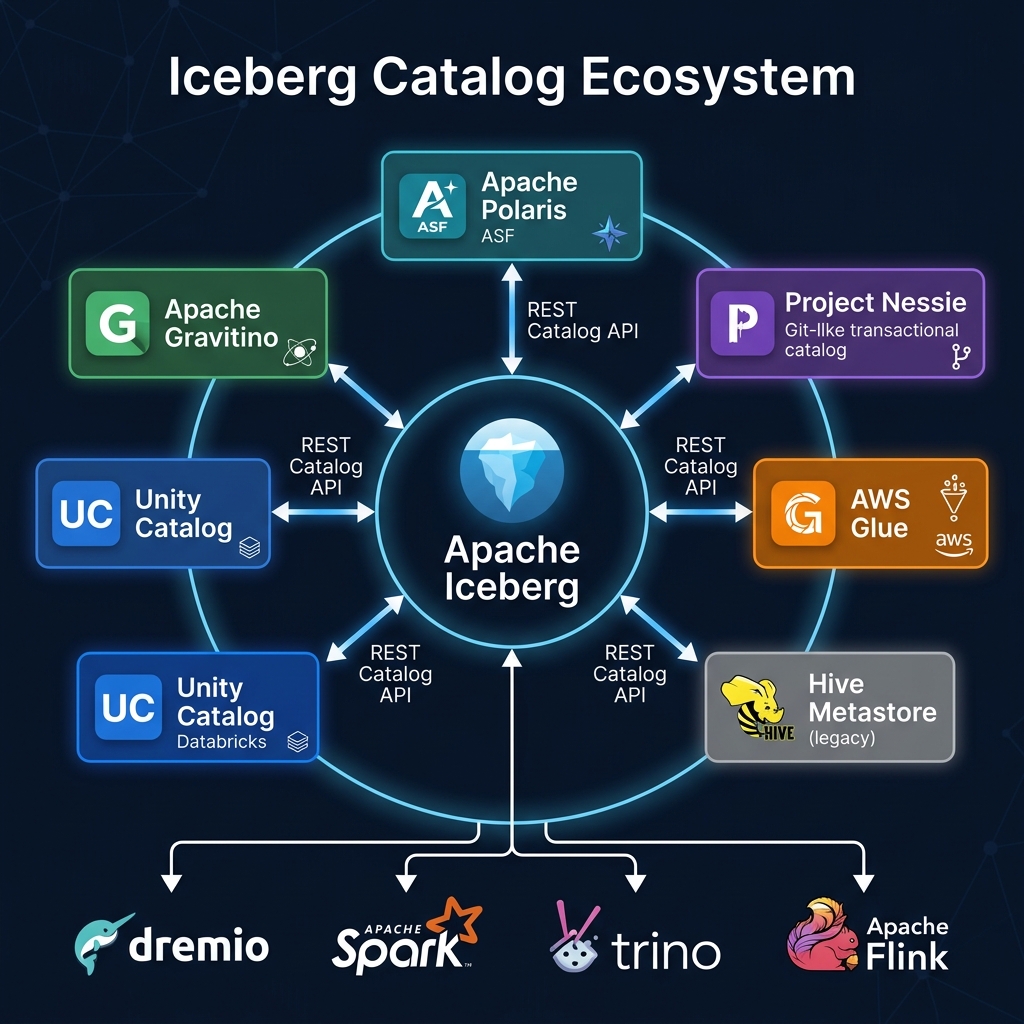
- Monte Carlo Data: The pioneering commercial data observability platform. ML-based anomaly detection across all five pillars. Native integrations with Iceberg, Glue, dbt, Airflow, and major BI tools.
- Acceldata: Enterprise data observability with strong on-premises support. Pipeline monitoring, quality scoring, and SLA tracking.
- Elementary Data (open source): dbt-native observability built on top of dbt tests. Generates HTML reports and Slack alerts from dbt test runs. Free for dbt-based pipelines.
- Soda Core (open source): SQL-based quality checks with a Python SDK. Integrates with DataHub and OpenMetadata for catalog-visible quality scores.
Summary
Data observability is the reliability engineering practice that makes data lakehouse operations production-grade. By continuously monitoring freshness, volume, schema, distribution, and lineage context, observability platforms catch data incidents in minutes rather than hours — before business users encounter stale, missing, or incorrect data in their dashboards. Combined with data quality checks in pipelines and lineage for root cause investigation, data observability completes the reliability toolkit for enterprise lakehouse operations.