What Is a Data Fabric?
A data fabric is an architectural approach to data management that creates a unified, governed, and intelligently connected layer across all of an organization's data assets — regardless of where they physically reside. Rather than requiring all data to be consolidated into a single physical platform (like a data warehouse or lakehouse), a data fabric connects data in place through a shared metadata layer, unified access APIs, and consistent governance policies.
Gartner defines data fabric as an architecture and set of data services that provide consistent capabilities across a choice of endpoints spanning on-premises and multiple cloud environments. The key principles are: data accessed where it lives (no forced copy), metadata-driven integration (intelligent discovery and preparation via active metadata), and consistent governance (unified policies applied across all data sources).
Data Fabric Core Components
- Active Metadata Layer: A continuously updated metadata repository that combines technical metadata (schemas, lineage), business metadata (descriptions, ownership), and operational metadata (usage statistics, quality scores). Active metadata drives automated data integration recommendations and access policy enforcement.
- Knowledge Graph: A semantic graph connecting data assets, business concepts, users, and policies — enabling AI-assisted data discovery and relationship inference.
- Data Integration: Federated query, replication, and transformation capabilities that move or access data across sources according to business rules.
- Unified Governance: Access control, quality, and compliance policies applied consistently across all connected data sources — cloud, on-premises, and edge.
- AI/ML-Assisted Operations: AI recommendation engines for data discovery (suggesting relevant datasets), integration (inferring mappings between heterogeneous schemas), and quality (detecting anomalies without predefined rules).
Data Fabric vs Data Lakehouse
The data lakehouse is often the central analytical component within a data fabric implementation, not a competing concept:
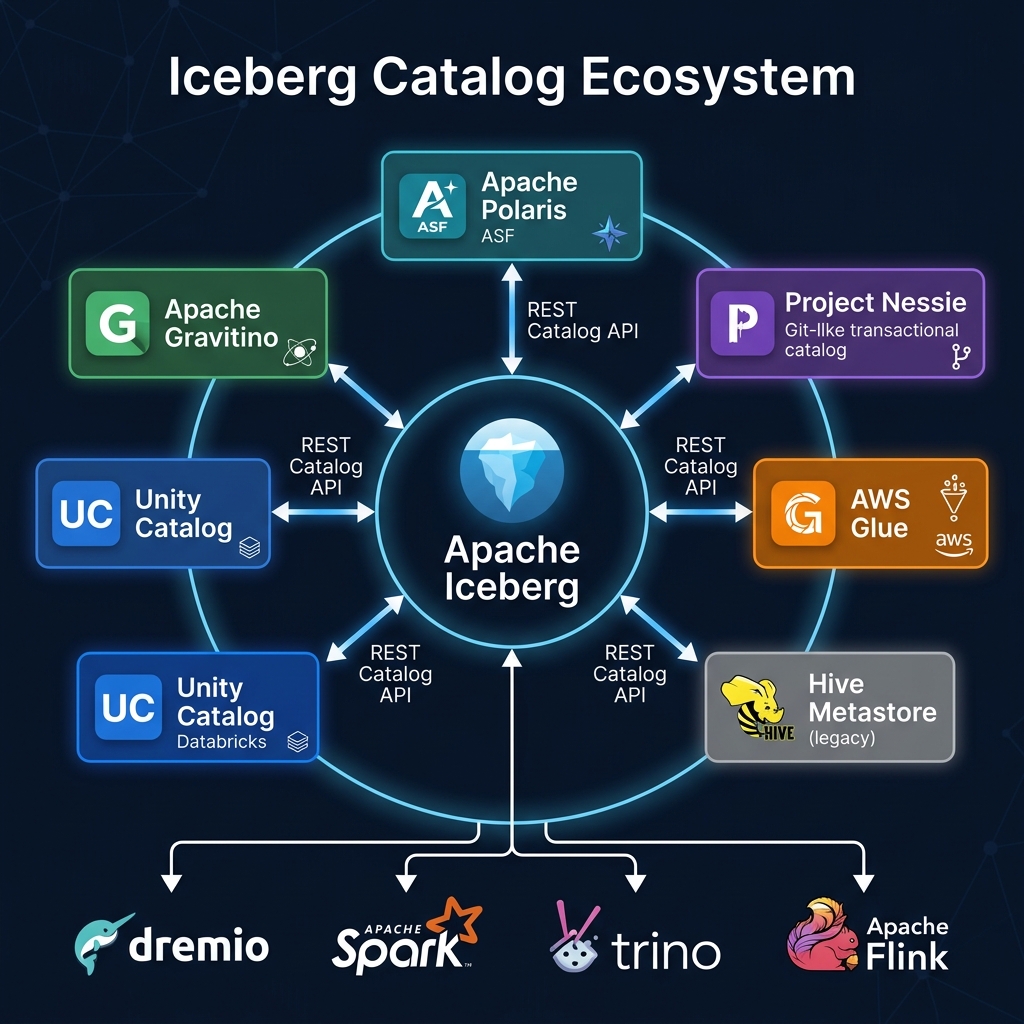
- The lakehouse provides the open, governed, high-performance analytical storage and query layer — Apache Iceberg tables on object storage queried by Dremio, Spark, or Trino
- The data fabric provides the broader integration, governance, and metadata management layer — connecting the lakehouse with operational databases, SaaS systems, streaming platforms, and other data sources through unified metadata and governance
Dremio's federation capabilities and the semantic layer are key data fabric enablers — providing the unified access point that connects the lakehouse to broader data estate resources.
Summary
The data fabric represents the next evolution of enterprise data architecture thinking — moving beyond physical consolidation to unified logical management of distributed data. While the data lakehouse provides the optimal analytical storage and query layer for structured data, the data fabric provides the governance, integration, and metadata management envelope that connects the lakehouse to the rest of the enterprise data estate. Organizations that combine an open lakehouse core (Iceberg + Dremio) with data fabric governance tooling (OpenMetadata, DataHub, active metadata) achieve the most comprehensive, scalable, and future-proof data architecture.