What Is Unity Catalog?
Unity Catalog is Databricks' unified governance and metadata catalog for the Databricks Lakehouse Platform. Introduced in 2021, it replaced workspace-level Hive Metastores with a centralized, account-level catalog that spans all Databricks workspaces — providing consistent access control, lineage, and discoverability across the entire organization's data and AI assets.
Unity Catalog uses a three-level namespace hierarchy: catalog.schema.table (compared to HMS's two-level database.table). This three-level structure allows organizations to organize data by environment (prod, dev), domain (sales, marketing), and subject area — providing more flexible organizational taxonomy than the traditional HMS structure.
In 2024, Databricks made a significant strategic move by open-sourcing Unity Catalog under Apache License 2.0. The open-source version (OSS Unity Catalog) can be deployed independently of Databricks and exposes an Iceberg REST Catalog API, enabling non-Databricks engines to connect.
Unity Catalog Governance Features
Unity Catalog provides comprehensive governance across all Databricks assets:
- Centralized RBAC: Account-level user management with workspace inheritance. Permissions assigned at catalog, schema, table, column, and row level
- Column-level security: Data masking policies applied transparently to specific columns for specific user groups
- Row-level security: Dynamic row filters applied based on the querying user's identity
- Data lineage: Automatic tracking of how tables are created and modified — which upstream tables each table depends on, which downstream tables depend on each table
- Audit logging: All data access events logged for compliance and security investigation
- Data discovery: Search-based discovery of tables, columns, and AI assets across the account
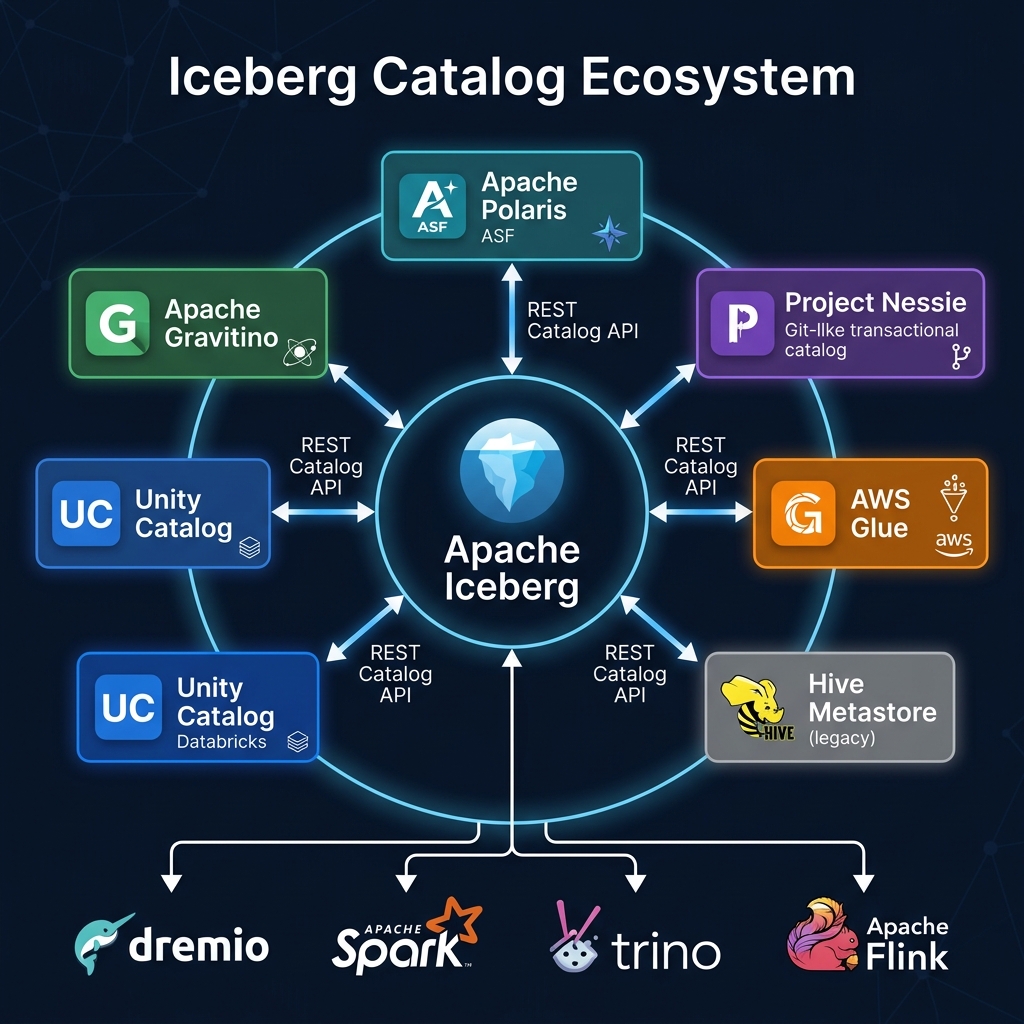
Unity Catalog vs. Apache Polaris
| Dimension | Unity Catalog | Apache Polaris |
|---|---|---|
| Governance scope | Tables, models, notebooks, files | Iceberg tables only |
| Lineage tracking | Yes (automatic) | No |
| Open source | Yes (Apache 2.0, 2024) | Yes (ASF) |
| Engine dependency | Optimized for Databricks | Vendor-neutral |
| Git-like branching | No | No |
| REST Catalog API | Yes (OSS version) | Yes |
Unity Catalog is the right choice for organizations fully committed to the Databricks platform who want comprehensive cross-asset governance. Polaris and Nessie are better choices for organizations prioritizing vendor neutrality and multi-cloud portability.
Summary
Unity Catalog is the most comprehensive governance catalog in the commercial lakehouse ecosystem — spanning tables, ML models, notebooks, and dashboards with fine-grained access control, lineage, and discovery in a single system. Its 2024 open-source release and Iceberg REST API support moved it into the broader ecosystem, making it a viable catalog for multi-engine environments. For pure Databricks shops, Unity Catalog is the natural choice; for organizations building on open standards and multi-engine lakehouses, Apache Polaris or Project Nessie provide stronger vendor neutrality.