What Is Apache Arrow?
Apache Arrow is an open-source project that defines a standardized, language-agnostic in-memory columnar data format and provides libraries for efficient analytical data processing in C++, Python, Java, R, Go, Rust, JavaScript, and other languages. Originally launched by Wes McKinney (creator of pandas) and Dremio in 2016, Arrow has become the universal in-memory data interchange standard for the analytics ecosystem.
Arrow's core contribution is a standardized columnar memory layout: a specification for how columnar data should be represented in RAM that is identical across all languages and platforms. When Python pandas, Java Spark, and C++ Dremio all use Arrow format internally, they can share data in memory without any serialization or format conversion — zero-copy data sharing between languages and processes.
This zero-copy property is Arrow's most impactful performance feature: in traditional analytics pipelines, moving data from Spark (JVM) to Python (CPython) requires serialization to a byte stream and deserialization on the other side — copying the data twice. With Arrow, Python and Spark can share the same memory buffer — no copying, no serialization overhead.
Arrow in Query Engine Architecture
Arrow is the in-memory data format for every modern analytical query engine:
- Dremio: Built entirely on Arrow — all internal data movement uses Arrow RecordBatches, enabling SIMD vectorized operators and zero-copy result transmission to Arrow Flight SQL clients
- Apache Spark (Tungsten project): Uses Arrow format for Python UDF data exchange (eliminating serialization overhead) and Arrow-based vectorized readers
- DuckDB: Uses Arrow format for in-memory processing and exposes an Arrow IPC interface for Python integration
- Pandas 2.0: Arrow-backed DataFrames as an optional storage backend for zero-copy interoperability with Arrow-native engines
Arrow Flight SQL: High-Performance Data Access
Arrow Flight SQL is a high-performance data access protocol that transmits SQL query results between servers and clients using Arrow columnar format over gRPC. It is designed as a high-throughput replacement for JDBC/ODBC for bulk data access scenarios.
JDBC transmits data in row-oriented format, serializing each row independently — efficient for small result sets but extremely slow for bulk transfers. Arrow Flight SQL transmits data in Arrow columnar RecordBatches — the same format the query engine uses internally. A Python data science workload pulling 100M rows from Dremio via Arrow Flight SQL avoids: JDBC serialization overhead, row-to-column conversion overhead, and Python object creation overhead — replacing all of these with a direct Arrow buffer handoff into PyArrow or Pandas 2.0.
Throughput improvements from JDBC to Arrow Flight SQL are typically 10–100x for bulk data access workloads — a transformative difference for data science and ML feature engineering pipelines.
Summary
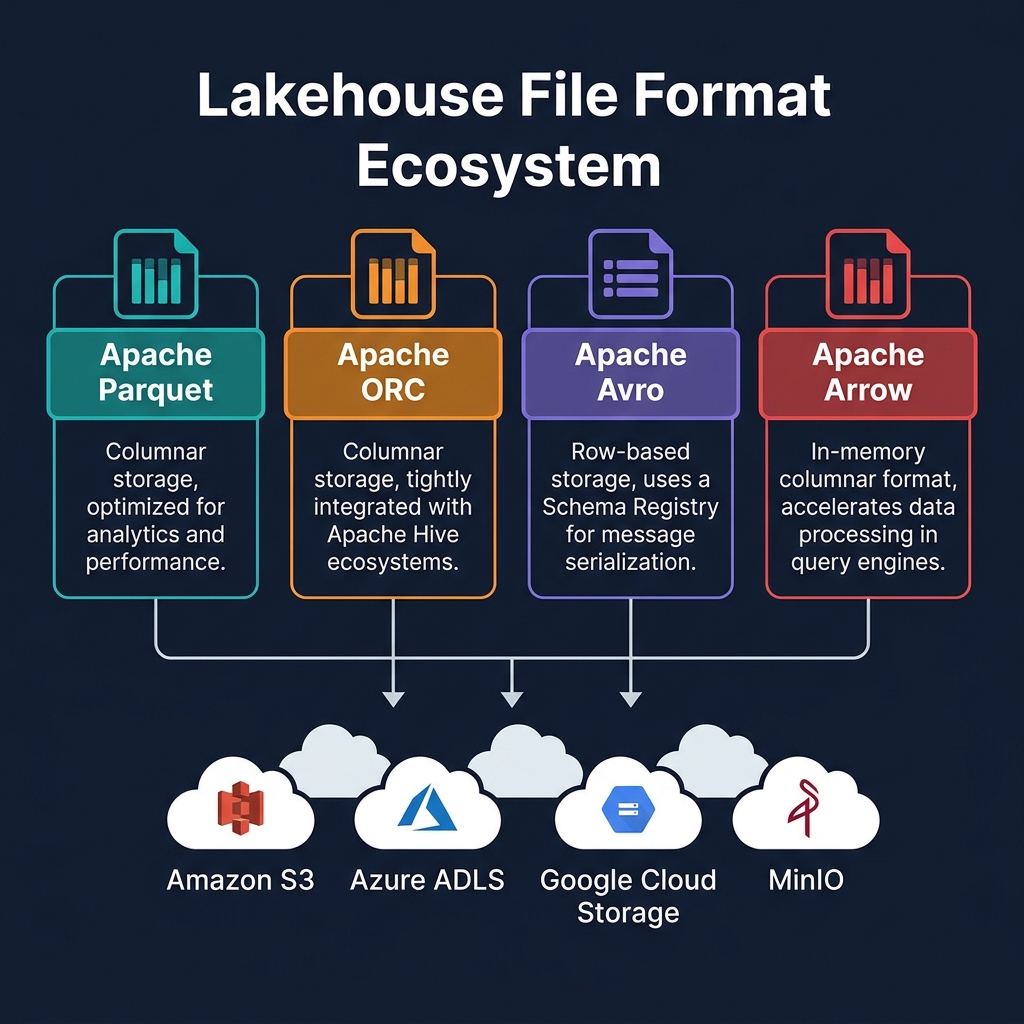
Apache Arrow is the performance infrastructure layer of the modern analytics stack. Its standardized in-memory columnar format enables zero-copy data sharing across languages, SIMD-optimized vectorized processing in query engines, and the Arrow Flight SQL high-throughput data access protocol. For the data lakehouse, Arrow is the invisible connective tissue that links Parquet files on S3 to vectorized engine operators, Python data science workloads to SQL query results, and AI agent data requests to enterprise lakehouse tables — all with maximum throughput and minimum overhead.