What Is RBAC?
Role-Based Access Control (RBAC) is the governance model where permissions to access resources are assigned to named roles, and users or service accounts are then assigned to roles — rather than granting permissions directly to individual users. RBAC scales gracefully: adding a new analyst means assigning them to the 'analyst' role (which already has all appropriate permissions), rather than granting 50 individual table permissions. Changing the permissions of all analysts means updating the 'analyst' role, which automatically applies to all role members.
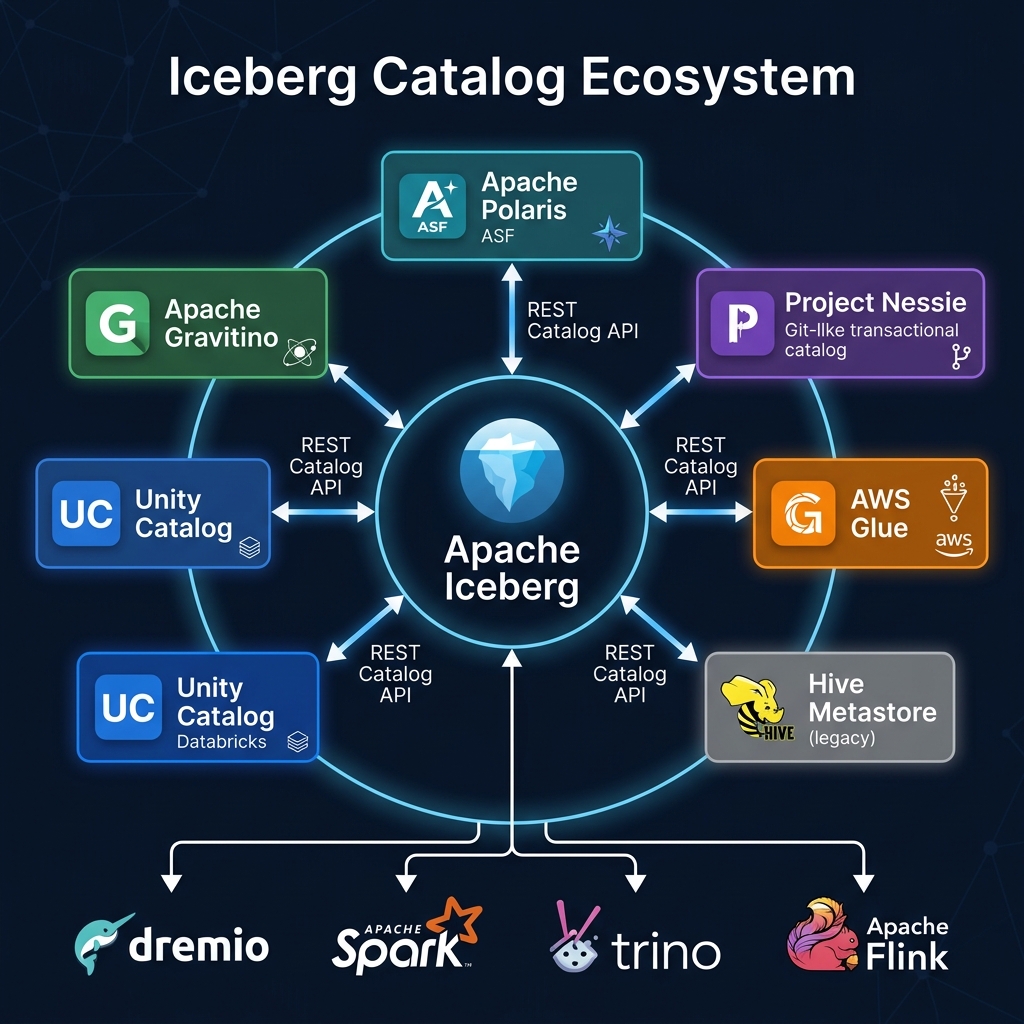
In the data lakehouse, RBAC is implemented at the Iceberg catalog level — where all engines connect before accessing table data. Catalog-level RBAC is the engine-agnostic governance standard: regardless of whether a query comes from Dremio, Spark, or Trino, the catalog enforces the same access policies.
RBAC in Apache Polaris
Apache Polaris implements a two-tier RBAC model:
Principals and Principal Roles
A Principal is a user or service account that authenticates with Polaris. Principal Roles are named collections that principals are assigned to — 'data-engineers', 'analysts', 'ml-team', 'bi-service-accounts'.
Catalog Roles and Privileges
A Catalog Role is a named set of privileges on specific catalog resources — namespaces and tables. Privileges include: TABLE_READ_DATA, TABLE_WRITE_DATA, TABLE_FULL_METADATA, NAMESPACE_CREATE, CATALOG_MANAGE_METADATA. Catalog Roles are granted to Principal Roles — connecting user groups to their permitted catalog resources.
RBAC in Dremio
Dremio implements RBAC across its full resource hierarchy:
- System-level roles: ADMIN (full system access), PUBLIC (default minimum access for all users)
- Custom roles: Named roles with specific permissions on specific Dremio resources
- Resource-level permissions: Each Dremio object (source, space, VDS, folder) has its own access control list — permissions can be set at the source level (all tables in a source), the schema level (all tables in a namespace), or the individual VDS level
- Column-level masking: Data masking policies that replace sensitive column values with masked equivalents for specific roles
Dremio's RBAC controls both the semantic layer (which VDSs a role can see) and the underlying data access (which physical sources a role can query through).
Summary
Role-Based Access Control is the governance backbone of the enterprise data lakehouse. Implemented at the catalog layer (Apache Polaris, Dremio Open Catalog), RBAC provides engine-agnostic, principled access control that scales from a handful of users to thousands without per-user permission management overhead. Combined with column-level security for fine-grained data masking, RBAC gives organizations the governance framework to make the open lakehouse both openly accessible and securely governed — enabling self-service analytics without sacrificing compliance.